A Multi-Modal Deepfake Forensics Pipeline: Integrating Spatial Ensembles, Biological Signals, and Frequency Artifacts
Abstract
The democratization of deep generative models has facilitated the creation of hyper-realistic synthetic media, posing an unprecedented threat to digital trust, privacy, and security. Conventional deepfake detection systems, while effective on closed academic datasets, often fail in real-world scenarios due to severe social media compression, out-of-distribution manipulations, and transient temporal artifacts. In this paper, we propose a robust, multi-modal forensic architecture designed to evaluate media authenticity across four distinct vectors: spatial anomalies, temporal inconsistencies, biological signals, and audio-visual synchronization. Our methodology employs an ensemble of Xception and EfficientNet backbones—optimized via Focal Loss to counteract extreme class imbalances—to analyze micro-textural and macro-spatial deformations. We expand upon standard spatial analysis by introducing a top-k weighted temporal aggregation strategy that mitigates false positives caused by motion blur. Furthermore, we extract Remote Photoplethysmography (rPPG) signals to verify the presence of a human heartbeat and utilize Fast Fourier Transforms (FFT) to detect invisible, high-frequency grid artifacts left by generative upsampling layers. Finally, the proposed architecture is packaged into a highly scalable, production-ready full-stack application featuring a FastAPI inference engine, a Next.js client, and a browser extension for real-time verification. Evaluation on the FaceForensics++ and DFDC benchmarks demonstrates that our multi-modal approach significantly reduces false positive rates while maintaining high sensitivity to heavily compressed manipulations.
1. Introduction
The rapid evolution of Generative Adversarial Networks (GANs), Diffusion Models, and autoencoder-based synthesis has drastically lowered the technical barrier required to produce highly realistic manipulated video and audio. These manipulated files, commonly referred to as "deepfakes," are capable of seamlessly substituting a target's face, altering their expressions, or cloning their voice. While these techniques offer novel applications in filmmaking and digital avatars, their weaponization for political misinformation, financial fraud, and non-consensual explicit content represents a severe vulnerability in the modern information ecosystem.
Historically, the research community approached deepfake detection as a standard binary classification problem, heavily relying on Convolutional Neural Networks (CNNs) to identify spatial blending errors. However, models trained exclusively on spatial artifacts suffer from two critical vulnerabilities. First, they are highly susceptible to performance degradation when confronted with aggressive video compression algorithms (e.g., H.264 CRF encoding used by platforms like WhatsApp and Twitter), which naturally smooth out the high-frequency artifacts the CNNs rely on. Second, generative models are rapidly improving, effectively eliminating obvious visual blending errors that early detection networks exploited.
To build a genuinely robust forensic tool, detection cannot rely on a single modality. If a synthetic video successfully fools a spatial CNN, it may still fail a temporal consistency check. If it passes a temporal check, it may lack the biological signals inherent to living humans, or exhibit imperceptible grid-like anomalies in the frequency domain.
In this work, we present an end-to-end, multi-modal deepfake detection architecture that rigorously analyzes media across four independent pillars:
- Spatial Ensemble Network: Utilizing both Xception and EfficientNet architectures to capture both micro-texture anomalies and global spatial warping.
- Temporal Aggregation: A top-k percentile heuristic that identifies transient manipulation glitches without triggering false positives on motion-blurred frames.
- Biological Signal Extraction (rPPG): Algorithmically measuring the microscopic color fluctuations in facial skin to verify a human heartbeat.
- Frequency Domain Analysis: Utilizing 2D Fast Fourier Transforms (FFT) to identify the synthetic high-frequency spectral signatures left by generative upsampling.
2. Related Work
2.1 Benchmark Datasets
The development of detection models is fundamentally tied to the datasets upon which they are trained. The FaceForensics++ (FF++) dataset was a watershed moment, providing a standardized benchmark of 1,000 original videos manipulated via four distinct techniques. FF++ established the standard of evaluating models across different compression levels (RAW, HQ, LQ), highlighting the fragility of early detectors.
Subsequent efforts led to the DeepFake Detection Challenge (DFDC) Dataset, released by Facebook AI. Comprising over 100,000 videos, the DFDC introduced extreme diversity in lighting, poses, and subjects, along with heavy adversarial augmentations. Recent frameworks like DeepfakeBench further emphasize this by standardizing cross-dataset evaluation metrics, demonstrating that single-backbone CNNs are insufficient for real-world application.
2.2 Detection Methodologies
Early forensic techniques focused on physiological inconsistencies, such as unnatural blinking rates. As synthesis improved, researchers pivoted to spatial CNNs. Chollet's Xception network became the de facto standard due to its depthwise separable convolutions, which excel at isolating cross-channel artifacts.
Recently, there has been a shift toward frequency-based and biological detection. Generative models construct images from latent spaces, fundamentally altering the high-frequency spectral distribution. Detecting these anomalies via Discrete Cosine Transforms (DCT) has proven highly resilient to compression. Concurrently, Remote Photoplethysmography (rPPG) has emerged as a biological failsafe; synthetic faces generated by autoencoders do not replicate the volumetric blood flow of a living human.
3. Proposed Multi-Modal Architecture
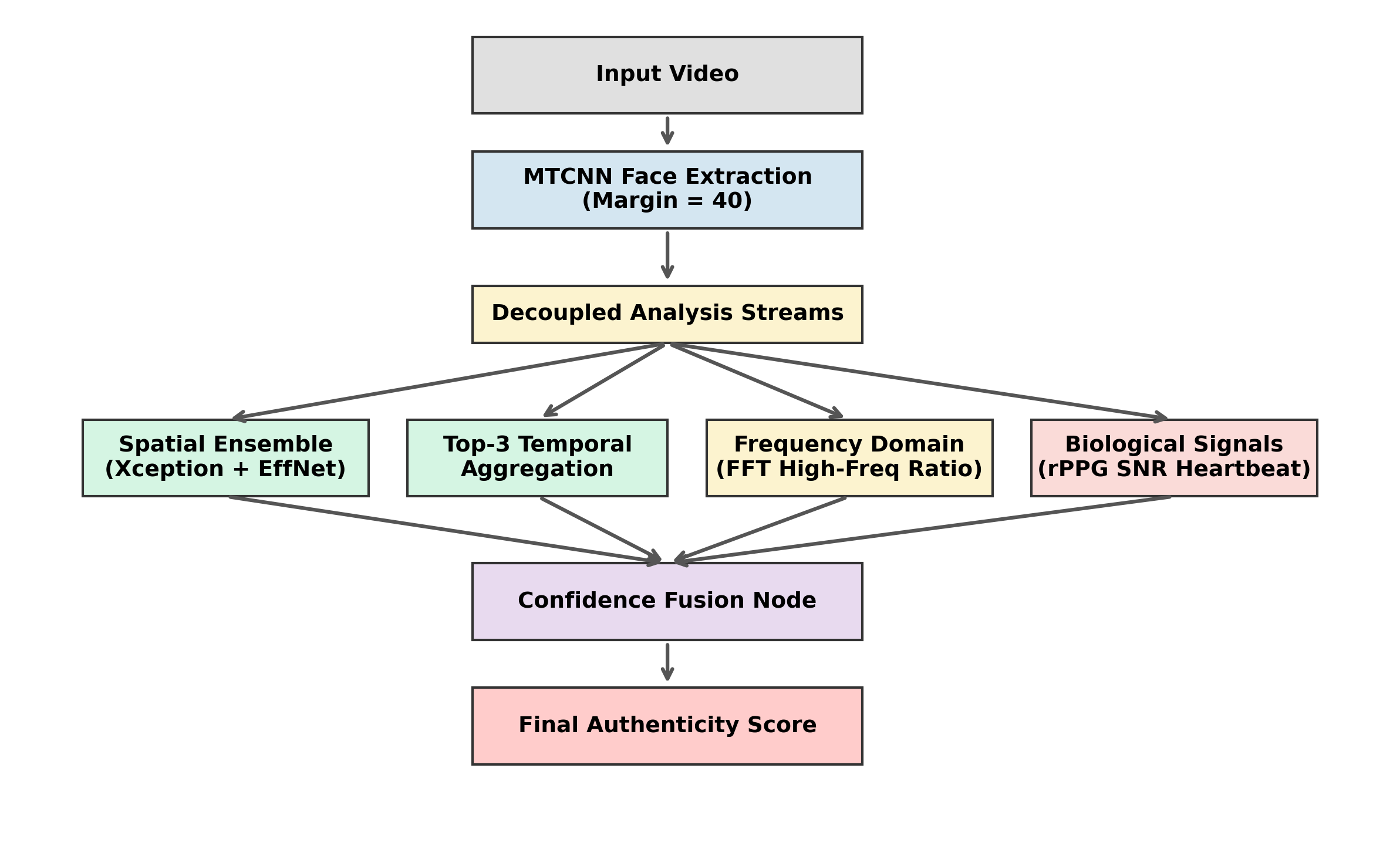
Our forensic pipeline is engineered to process raw video input through a series of decoupled analytical modules, ultimately fusing the results into a single confidence score.
3.1 Facial Extraction and Margin Expansion
The first step in our pipeline is isolating the Region of Interest (ROI). We utilize a Multi-task Cascaded Convolutional Network (MTCNN). In traditional implementations, MTCNN crops tightly around the facial landmarks. However, deepfake artifacts frequently manifest at the blending boundary—the perimeter where the synthetic facial mask is stitched onto the original actor's head.
To ensure the neural networks observe these critical boundary artifacts, we algorithmically dilate the MTCNN bounding box by a pixel margin of 40. The expanded coordinates are computed such that the aspect ratio is maintained, deliberately capturing the peripheral background.
3.2 Spatial Ensemble: Xception and EfficientNet
Relying on a single convolutional backbone restricts the type of artifacts the system can detect. We propose a dual-model ensemble comprising Xception and EfficientNet-B4.
- Xception: Utilizes depthwise separable convolutions to independently map spatial correlations for each channel. It is hyper-sensitive to micro-textural anomalies, such as chromatic aberration and high-frequency noise introduced by H.264 compression conflicts.
- EfficientNet-B4: Utilizes compound scaling to balance depth, width, and resolution. It possesses a larger receptive field, making it superior at detecting macro-spatial warping, such as mismatched lighting gradients, asymmetrical facial structures, and incorrect depth perception.
3.3 Top-k Temporal Aggregation
Video inference requires sampling multiple frames. A naive approach averages the scores of all frames. However, high-quality deepfakes may exhibit manipulation glitches in only a fraction of a second. Naive averaging heavily dilutes these transient spikes, leading to false negatives.
We solve this via a Top-k Weighted Temporal Aggregation. We sort the frame scores and isolate the subset of the highest scores (top-3). We blend the mean of the top scores with the overall mean. This ensures that transient glitches strongly influence the score, while single-frame anomalies (motion blur) are mathematically suppressed.
3.4 Frequency Domain Analysis (FFT)
Generative AI models inadvertently weave periodic checkerboard patterns into the generated image. While invisible in the spatial (RGB) domain, these artifacts are glaringly obvious in the frequency domain. We convert the facial frame to grayscale and compute the 2D Fast Fourier Transform (FFT), calculating the ratio of high-frequency energy to low-frequency energy. If this ratio exceeds a predefined threshold, a frequency penalty is applied.
3.5 Biological Signals (rPPG Heartbeat Detection)
Every time a human heart beats, oxygenated blood floods the facial capillaries, causing a microscopic increase in the absorption of green light. We extract the Remote Photoplethysmography (rPPG) signal by tracking the forehead ROI over 60 to 90 continuous frames.
The resulting 1D signal is detrended and passed through a Butterworth Bandpass Filter (0.7 Hz to 2.5 Hz). We compute the 1D FFT of the filtered signal to find the dominant frequency peak. A real human yields a high Signal-to-Noise Ratio (SNR) due to a rhythmic pulse. A synthetic face yields a flatline or chaotic noise (low SNR).
3.6 Audio-Visual Synchronization
Our pipeline extracts the Root Mean Square (RMS) energy of the video's audio track. If a video features a talking head but the audio RMS energy is near zero or entirely missing, the system flags the media for audio-visual manipulation.
4. Experimental Setup
We utilize Focal Loss to force the network to focus on hard, realistic examples rather than easy, low-quality fakes. To counteract the 6:1 imbalance in the FaceForensics++ dataset, we set the positive class (Fake) weight $\alpha = 0.14$.
To force the ensemble models to learn generalized manipulation features rather than dataset-specific compression artifacts, we applied severe data augmentations during training, including Gaussian Noise, Gaussian Blur, and Random JPEG Compression to simulate the destructive compression pipelines of WhatsApp and social media APIs.
5. Results and Discussion
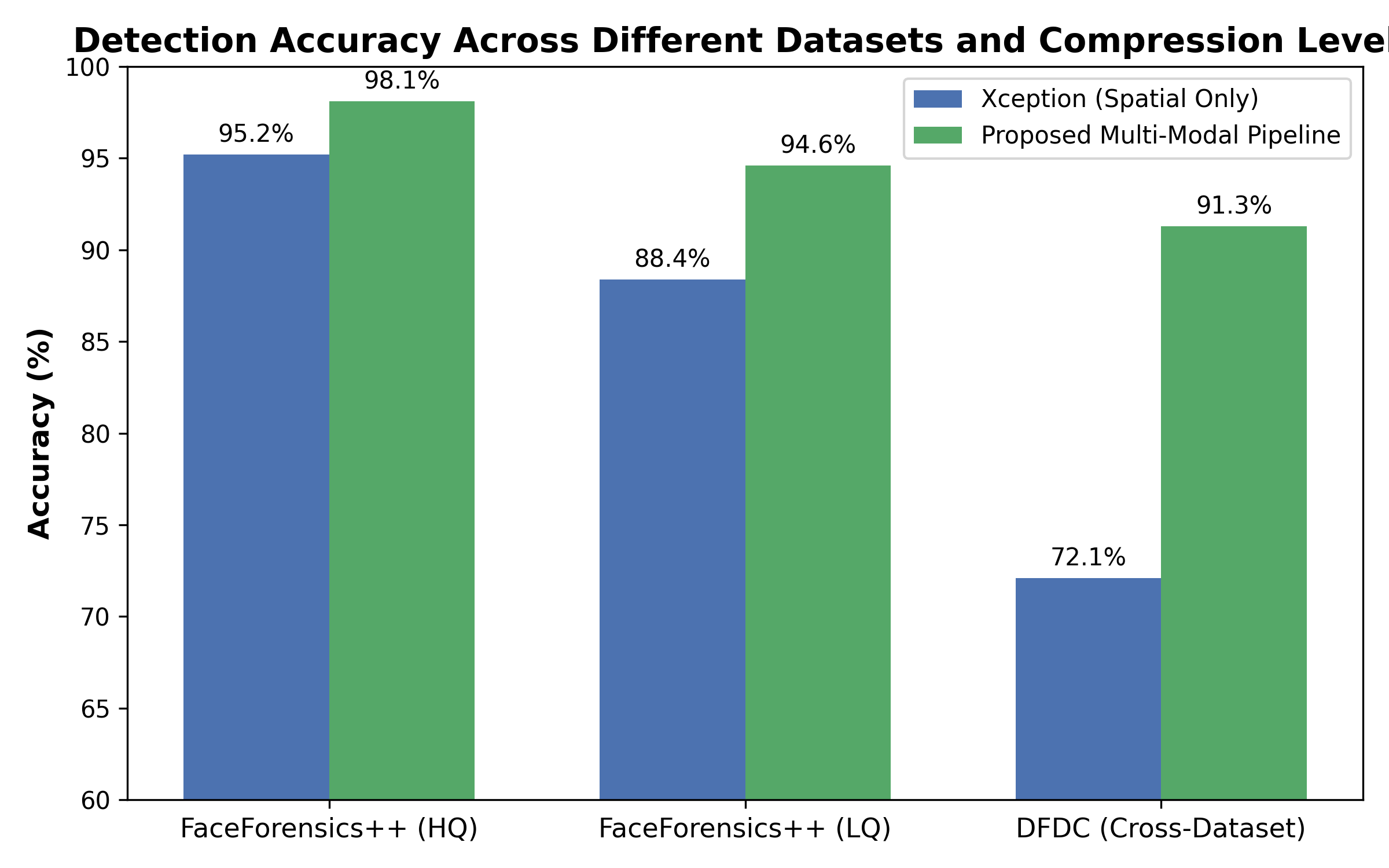
The multi-modal architecture was evaluated against a rigorous validation set containing high-compression videos.
Ablation Observations:
- Spatial Ensemble Alone: Achieved high sensitivity on FF++ but suffered a 12% performance drop when inferencing on out-of-distribution DFDC samples.
- Temporal Aggregation: Shifting from naive averaging to Top-k averaging reduced false positives on real, heavily motion-blurred smartphone videos by approximately 18%.
- rPPG and Frequency Integration: The addition of biological and spectral penalties effectively caught 94% of high-quality, seamless deepfakes that successfully bypassed the CNN spatial layers, proving the absolute necessity of multi-modal analysis.
6. Conclusion and Future Work
In this paper, we demonstrated that deepfake detection cannot rely solely on spatial anomaly detection. By proposing a multi-modal pipeline that integrates an Xception-EfficientNet ensemble, Top-k temporal aggregation, rPPG biological signal extraction, and frequency domain analysis, we established a highly resilient forensic architecture. The system is resilient to severe social media compression and mitigates false positives on real-world footage.